And the bush has friends to meet him, and their kindly voices greet him, In the murmur of the breezes and the river on its bars,
And he sees the vision splendid of the sunlit plains extended, And at night the wonderous glory of the everlasting stars.

Banjo Paterson (1889)

Thursday, June 7, 2012

Thailand Birding - Khao Yai to Kaeng Krachen

Early last year we were birding in the north of Thailand, now it was time to look for the birds in more southern regions, especially the pittas! We had 13days of full birding and for most of it we were to be with bird guide Nick Upton from Thaibirding. We had a big wish list, with lots of pitta species, I think this made Nick sweat a little bit, he had his work cut out for him!


First stop Khao Yai for 3 days (after Limestone Wren-babblers at Wat Praputtabaht Noi). Blue-winged Pittas were easy to get, as they seemed to be calling all over the countryside, but the others would be harder. Climate change it seems has affected Thailand's rainforest birds, with many not calling or responding, and many on nests. Lots of walking along tracks and in the rainforest did result in us seeing wonderful birds such as Long-tailed Broadbills, Moustached Barbet and Banded Kingfisher.


Our second pitta species was this beautiful Hooded Pitta, shy, but not as shy as the Blue Pitta which came next. I got a fairly good quick look, but my wife Liz was sweating, as she only caught a non-tickable glimpse. We were to get better views later at Kaeng Krachen.


A big area of dense rainforest for a little pitta, or even a Giant Pitta to hide in. We managed to get good views of a number of Siamese Firebacks, but Coral-billed Ground Cuckoos were not to be seen, it seems they are not as easy to see in the park as they use to be. One bird we were very lucky to get good close views of, was the hard to find Jerdon's Baza!


Lots of walking along rainforest trails in Khao Yai, interesting fungi, but also lots of hungry leeches. At the end of the trip, the score was 5 leech bites for Liz and only 1 for me. Maybe it was because often I walked last and managed to usually see the hungry little (and big) guys waving around and dodge them!


One evening was spent looking around for Great-eared Nightjar, which we got in an open section of the park, an area often frequented by these lovely Red Muntjacs.


It was time to head back to Bangkok before heading towards Kaeng Krachen, but first a stop at the Muang Boran fishponds, a wonderful area near Bangkok for waterbirds.


The fishponds had big numbers of these (often scruffy looking) Asian Openbill Storks, which fed on the introduced Giant Snails. The area also had large numbers of Indian Cormorants, Pheasant-tailed and Bronze-winged Jacanas, as well as Cotton Pygmy-goose, Lesser Whistling Duck and Black Bittern. 

After a night in Bangkok, it was off to Kaeng Krachen with it's amazing birds and fantastic butterflies (which I'll have to find the names of one day).


These butterfly photos were all taken while standing at a small bridge for 10 minutes!


Monday, June 4, 2012

Gurney's Pitta Update - Hurry if you want to see one.


I have just returned from birding for 13 days in southern Thailand, with some hard birding, due to it seems climate change according to the guides, rain cycles totally out of sync for last year and this year affecting many rainforest birds. 250 bird species were seen, including 6 pitta species, so I’m happy.

The info about Gurney’s Pitta at Khao Nor Chi Chi is pretty bad, so if you want to see one you better hurry (maybe ~ 6 pittas left?). Climate change and disturbance in the park are affecting the pitta in a bad way, photographers are the main culprits with numerous photographers and videographers setting up hides and playing Gurney’s Pitta calls all day long. It seems they only care about getting the perfect photo, not the bird’s welfare! Most (not all) of the recent photos and Youtube videos have been obtained this way. We saw one of these guys in a hide at another park trying to get Blue Pitta photos, playing the call for hours!

We spent two days looking for the pittas with local bird guide Yotin, finally got great views of a male and female Gurney’s for about 2 minutes, male and female in the same view. Yotin is the pitta expert, but even he had trouble finding any Gurney’s in the last 6 months, a number of international birding companies missed out on seeing them! I would recommend hiring Yotin, as he has assistants out with radios to find the pittas, otherwise you could spend a whole week walking the overgrown and poorly signposted trails and not see one. This was a common statement in the bird log book at the Morakot Resort!

The situation with the 2 Gurney’s Pittas we saw is not very good, as it seems the male has paired with his daughter! The ‘official pitta rescue project’ also hasn’t helped, by ‘illegally’ taking wild Gurney’s for breeding, which resulted in the pittas not breeding but dying, a lot of it due to lack of experience of the ‘researchers’. Maybe they should have tried breeding some more common pitta species first! The Gurney’s Pitta will probably disappear from Thailand shortly and the population found in Burma are in hard to get to locations, so it’s best to hurry if you want to see one.

As for the birding situation in the far south near the Malaysian border, DON’T GO. Extremists are killing people on a daily basis, with guys riding motorbikes along forest tracks with machine guns and killing whoever they find! Beware, there is at least one southern Thailand birding company that doesn’t even mention the trouble down there, some just say that no tourist has been hurt! Possibly because no tourist go there and the rebels haven’t been able to find one to gun down or keep as a hostage?


This is not my video, but I think it may be the last views of an another truly beautiful bird that humanity will send into extinction. The lack of sound in the video is appropriate as the forest will no longer echo with the pitta's calls.

Thursday, May 3, 2012

Tom Price

Just returned from a long 10 day camping fauna survey near the Pilbara town of Tom Price. The days were in the mild low 30's and the flies and insects weren't too bad, so I can't complain, but it still seems a long time when living in a dusty basic bush camp and not being able to have all the amenities.


Most of the area around Tom Price is rocky and dry, but there are a few gems hidden away along some of the rivers, such as this pool about an hour's drive from the camp.


The camp, a little basic and dusty, especially when a strong wind springs up, but inhabited by a nice fauna team.


My home for the next ten days, a swag to sleep in and my big duffle bag. Sometimes at night you would hear a pack of  Dingoes close by and hoped that one of them had not run off with one of your work boots in the morning!


Many of the river systems in the area are dry and only carry water during heavy rains. My job for the fauna survey was mainly birding and it's wonderful to bird here in the cool mornings with hundreds of Budgerigars and Cockatiel flying overhead. I can walk along these river systems all day!


Sometimes during the river surveys you come across these beautiful big pools, teeming with White-plumed Honeyeaters, Sacred and Red-backed Kingfishers, and Whistling Kites.


Some of the pools are very long and deep, but not the best place to camp, due to the swarms of hungry mosquitoes that come out in the evening.


This is the general habitat around Tom Price, dry stony red clay soils with mulga woodlands and spinifex. Good areas for arid zone birds such as Chestnut-rumped Thornbills, Crested Bellbirds and Spotted Harriers.


One of the local reptile residents of these dry stony woodland areas are the Ring-tailed Dragons (Ctenophorus caudicintus).


Some spinifex sites were fantastic, having not been burnt for a long time, the hummocks were over a metre high and two metres across! Wonderful areas for many reptiles and small mammals, as well as Spinifexbirds and Rufous-crowned Emu-wrens.


The fauna team, enjoying a nice cool refreshing soak and the end of a long hot dusty day of fauna surveys.


This remote well with a good water supply, was a great magnet for local fauna, such as Bourke's Parrots and the elusive Grey Falcons.


A new bird for me and one I almost missed out on, the Grey Falcon, with the rest of the fauna team seeing it during the survey at various times, but me always being at the wrong place at the wrong time! Finally on the last day, only half an hour before packing up and leaving this survey area, I got him!


So ended a tough, but enjoyable bird and fauna survey. The area around Tom Price is harsh, but also a very beautiful and magical place.


Thursday, April 19, 2012

The Big Year

Most birders have by now probably seen the movie, The Big Year, released officially in November in Australia. Some saw it earlier on airline flights and some may have obtained 'copies' on the internet, as many people now do unfortunately. The reason I say unfortunately, as in this case the movie was a flop and lost millions of dollars, money that won't be partially recovered from DVD sales, due to the many illegal copies out there. This I think will result in Hollywood saying, never make a 'birder' movie again!

This would be a shame, as I think it was a good movie and one that grows on you the more you watch it. This is the reason for this blog post, having watched it again recently, I enjoyed the movie even more and think it's one of those in our collection that we will be able to watch over and over again.


The original story came from the book by Mark Obmascik, if you want to read the outline of the story from the book, please see the review at Booklog of the Bristol Library. Of course Hollywood changed the names and some of the story, but as the review said, 'the spirit remained true'.


I think one of the reason the movie didn't rate very well with the general public, is the video trailer shows it as a comedy, as well as having the three big stars, Steve Martin, Jack Black and Owen Wilson, you would expect some type of slapstick comedy. The movie does have comedy, but often it's subtle and the film tends to focus on relationships, competition and the costs of obsessive birding.

I think the other reason the movie wasn't 'a hit' was, well it's about birding! To us birders a lot of what occurs in the movie is fairly normal to what we do, but to the general public (and most of our friends) it's just weird. Birders are generally viewed as only one notch above train-spotters!

I'd say if you haven't seen it yet, go see it, or if you have, watch it again sometime. No, I have no shares in the movie or vested interests. I just think it's a shame that many birders and others have knocked the movie, a movie that finally give a view to outsiders of the fun and passion many of us birders have!

For more info, see The Big Year on Wikipedia.


Saturday, April 14, 2012

Neale Junction - An Easter Parrot Hunt

Last October Liz and I tried to get out to Neale Junction in the Great Victoria Desert, but unseasonal storms and rain made it unwise to try and travel that far out into the desert. If only we had luck on our side, we would had made it there to see an unusual abundance of rare and hard to find desert-loving Princess and Scarlet-chested Parrots! Now it was Easter 2012 and with our friends Rob and Bel, we decided it was time for another attempt.


First night's stop was the old Goongarrie Homestead north of Kalgoorlie, a place we had often driven past, but never visited. It turned out to be a great place to stay, except for the swarms of hungry mosquitoes that plagued us as soon as the sun began to set! It's a good birding area that we will hopefully visit one spring, especially after seeing Chestnut Quail-thrushes running around on the entrance road.


Next night we had camped at Point Sunday and explored the surrounding area hoping to maybe see the parrots, but no, compared to last October the area was quiet. Lots of White-fronted and Grey-fronted Honeyeaters, but no vast flocks of Budgerigars or Masked Woodswallows from last time, even though the woodlands looked very healthy from recent rains.

We began our journey along the 'Anne Beadell Highway', the rocky and often sandy track leading to Neale Junction. A good lunch spot was this interesting rock outcrop, about half way along the 'Highway'.


When conditions had been wetter, the Fairy Martins had been busy building their little colony of mud bottle nests.


Finally near the famous Neale Junction, the sign at the western entrance to the nature reserve. Rob, Bel and myself, happy that after the long hard drive we are near the camping area for the night. We are also happy due to having great views of a party of beautiful Rufous-crowned Emu-wrens shortly before.


Hmmmmmmm? The Neale Junction camping area was a little uninspiring, especially due to the armies of small black ants that covered the area. Having our swags on the ground, I spent half the night knocking the ants off my face, who have a bad tendency to become really aggressive and bite if any of their number get hurt!

We searched the surrounding area in the morning, but alas, due to a strong cool westerly wind, the conditions were not the best and no parrots were seen or heard. It seems that the large numbers of Princess and Scarlet-chested Parrots (last recorded in Janurary) had moved to other locations.


Men and their machines! Rob with his new Suzuki Vitara and me with the beasty Troopy. The Suzuki might look like a toy, but was a very capable small four wheel drive.


Time for some photos at the actual cross-roads of Neale Junction, the Anne Beadell heading east-west and the Connie Sue heading north-south.


Signing the visitors book at the junction. It seems there was usually someone passing through at least once a week over the last few months, but still a long time to wait if you broke down in this remote area.


Before heading back to Point Sunday, we searched for the parrots northwards along the Connie Sue Highway, but again no luck. Time to head back!


Back at Point Sunday camp and again after searching the surrounding areas, no luck. I'm sitting in my chair and having a beer (and a little cry) and wondering how many parrots we may have seen if we made it last October! Oh well, we did get 55 bird species for the trip, plus two new birds for our Australian life list. I'm sure we will be back out here again, as soon as we hear of new parrot sightings.


Wednesday, April 11, 2012

Pelagic Birding - The Results

First a thanks to all the people wishing me well, and no I wasn't sick. The tablets, salty chips and bread stick worked a treat!


My wife Liz and everyone else are ready to go birding, but no boat! It was almost a non-event, due to the deckhand who had the boat keys and probably had a long wild night before and just wanted to sleep, but he was finally contacted and eventually turned up with the boat.

The weather was windy with a few showers and a 2 metre seas and swell. Not a bad day for a boat trip west of Rottnest towards the Rottnest trench.

The official pelagic list from the Western Australia Recent Bird Sightings was:

Streaked Shearwater (40+)

Flesh-footed Shearwater (50+)

Wedge-tailed Shearwater (10)

Hutton's Shearwater (12)

Indian Yellow-nosed Albatross (1)

Great-winged Petrel (15)

Soft-plumaged Petrel (1)

Wilson's Storm-petrel (12)

Brown Skua (4)

Arctic Skua (1)

Bridled Tern (4)
 
The most interesting birds sighted were the large numbers of Streaked Shearwaters, not usually known to occur in Perth waters, especially in such numbers. Were they pushed down by a recent cyclone or is this a regular event? Another pelagic trip in April next year is planned to find out.
 

Saturday, March 31, 2012

Pelagic Birding


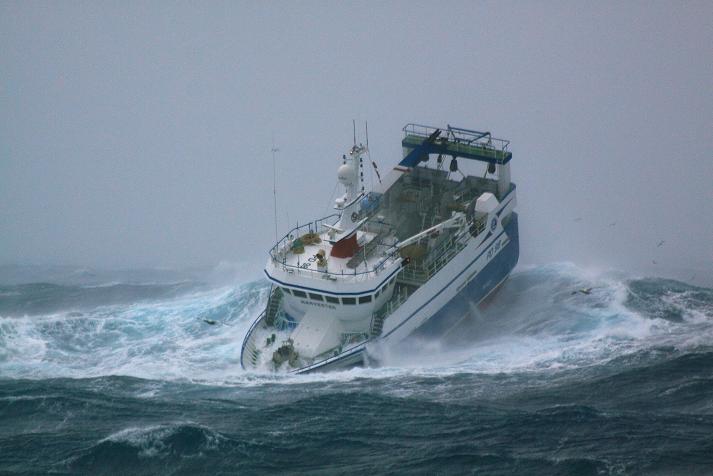
After my last pelagic birding trip about 16 years, which was a little like the picture (well maybe not quite that bad, but it felt like it), I'm booked in for one tomorrow. An all day sea-birding adventure beyond the continental shelf, the first ever autumn seabird trip off Perth.

A chance to see Arctic, Pomarine and Long-tailed Skuas (Jaegers) which may be on the move, plus a whole host of wonderful albatross, petrels and shearwaters. Hopefully I'll be better than that last trip, where I spent the second part of the day staring at the floor, slowly nibbling my 2 foot bread stick with people throwing up all around me! For those who have seen the movie The Big Year, it's probably going to be like the scene where Bostick keeps saying 'Pitching and tossing, pitching and tossing'.

Oh well, must get my seabird numbers up, so I'm armed with my supply of sea sickness tablets, some salty chips and the good old trusty bread stick!