And the bush has friends to meet him, and their kindly voices greet him, In the murmur of the breezes and the river on its bars,
And he sees the vision splendid of the sunlit plains extended, And at night the wonderous glory of the everlasting stars.

Banjo Paterson (1889)

Monday, November 7, 2011

Istanbul - Chora and Galata

The birding tour was almost upon us, but there was still time to see a few more of the ancient places of Istanbul. Chora and Galata were sites I hadn't thought about visiting, but I'm so glad we did, even though the day turned into quite an adventure.


The remains of the great Palace of the Porphyrogenitus.


Our walk began near the Golden Horn in the Western Districts of Istanbul. A word of warning, don't fall for the dropped brush by a shoe-cleaner trick, we did. It's in the big Loney Planet guide to Turkey, but not in our smaller Istanbul guide. A shoe-cleaner guy walks by and drops his brush, offers a shoe clean for picking up his brush, then bingo, tries to charge you a huge amount for cleaning you shoes! We didn't give him much in the end, but it was an unpleasant start to the day.


The palace complex was built in the 13th century, now theres a lovely little park at the base for the local residents.


The wonderful Byzantine palace after the 1453 conquest was used to house wild animals, a brothel and as a poor house for the Jews.


Amazing brickwork, as in many Byzantine buildings.


The Theodosian Walls, with restoration work. The walls are vertical and very high as you can see, something I would dread shortly!


The old and the new. I like this photo of a modern children's play area set in walls built around 400 AD.


This is where my dread of the walls really began. As I have become older, I now have a fear of heights. To get on top of the walls (which we wanted to do) there are steps, very steep narrow ones, with no rails. You can see them past the trees, they look like a vertical section of the wall.
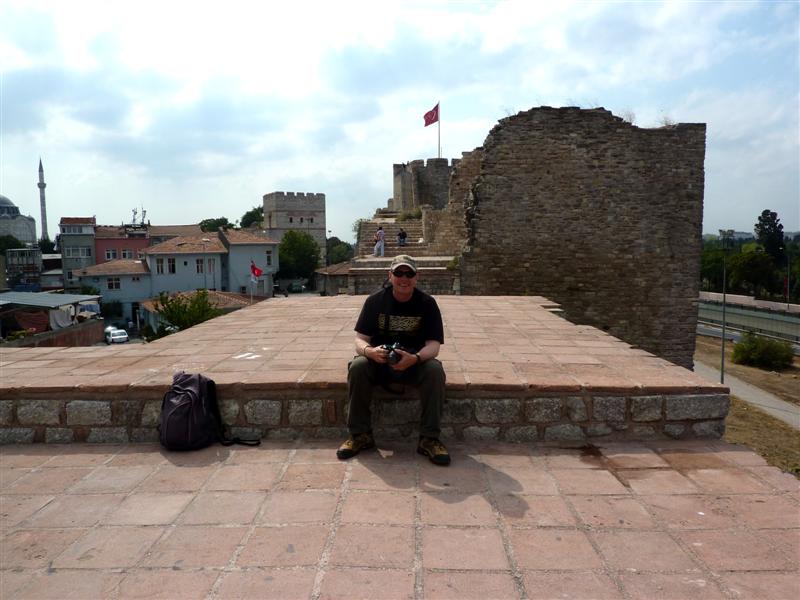


I'm smiling, but I'm not too happy, I have to get down yet.


Liz has no problem, but either side it's a 4 storey sheer drop onto the road below.


Great view of Istanbul, but 'Stay away from that edge!'


These are the steep crumbling steps. Beyond that edge you can see, the steps are narrow, short and at about an angle of 70 degrees. It was worse going down, but I didn't die, so it was a good day!


'Get out, I'm not doing that!' The next section of the walls was higher and even steeper with smaller steps!
We went to Chora Church instead.


The amazing Chora Church, tucked away in the back streets of Istanbul.


A fantastic looking brick church built in the 5th century.


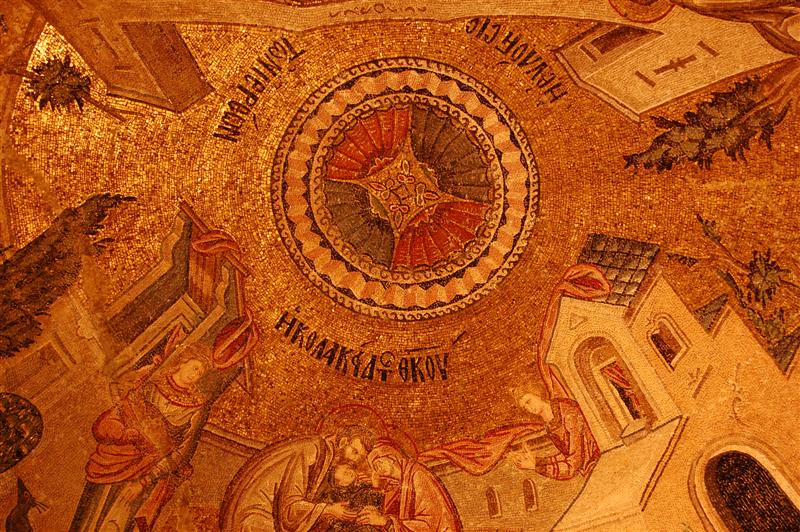
For a small church, the amount of wonderful mosaics and paintings is staggering.


'Reflection'. I like this photo of Liz at Chora.


Another of our destinations, The Galata Tower, across the Golden Horn in the crowded Istanbul suburb of Galata.


Narrow winding streets lead to the top of the hill and Galata Tower.


The beautiful and interesting Galata Tower.

It's 67 metres tall, has a shop, restaurant, observation deck and lots of stairs.


The bridge we had to cross to get to Galata from the main part of Istanbul, with the Aya Sofya, Blue Mosque in the background, and smaller New Mosque in the foreground.


Looking down the Golden Horn. Wonderful 360 degree views form the observation deck, which is almost 52 metres above the ground. I have no height worries if there's a good rail!


The Golden Horn entrance into the Bosphorus, looking towards the Sea of Marmara.


Our hotel somewhere on the other side of the Bosphorus and the Camlica Hills, where our birding tour would take us tomorrow.


Saturday, November 5, 2011

Istanbul - Aya Sofya

If you go to Istanbul and have to only see one site, it is without doubt Aya Sofya (also known as Hagia Sophia in Greek). This was my main ancient site that I wanted to see in the whole of Turkey.


This is a wonderful view of Aya Sofya along the tree-lined road from the Hippodrome. The tourist queue to get into Aya Sofya can sometimes stretch to almost this point, it's very popular!


The size of the building and amount of bricks used to build Aya Sofya is staggering. An interesting note, there has been a church here since the year 360 AD.


Once in, you enter the first hallway, which is massive in itself....


You then enter the main dome area dwarfs everything.


The dome is an amazing 55.6 metres (182 ft) above the floor.


Constantinople fell to the muslims, Sultan Mehmed, in 1453. Aya Sofya was then converted from a church to a mosque. Today it's a fantastic museum.


The Sultan could attend prayers in his lace box, without being seen by the public.


The apse mosaic of the virgin mother and child.


Lots of wonderful stained glass windows.


The main dome has fantastic artwork, a lot of it restored.


The central muslim artwork.


Strange looking angels at the corner points.


The tomb of Enrico Dandolo, the Doge of Venice, who in 1204 diverted the crusaders to attack Constantinople, a fellow Christian city, purely for greed. A disgraceful event, but tradition says that after the conquest of the city by muslims in 1453, his tomb was opened end his bones were thrown to the dogs!


The Omphalion, inlaid marble where Byzantine emperors sat on their throne, while being crowned.


Ancient Christian symbols on the ceiling, showing through the over laid muslim designs.


Marble that looks like some Aboriginal design. Many relics and artworks were stolen by the crusaders in 1204 and others removed after the 1453 conquest.


Hallways surround the main dome area.


Some wonderful light streaming onto an interesting (modern looking) design.


The ramp entrance lead to the upper level, it becomes quite narrow and claustrophobic, as it twists it's way up.


The view from the upper level is wonderful.


The upper level hallway.


The large green medallions with the names of God, Mohammed and the early calipahs, were erected in the 19th century.


The chandeliers look great.


People are dwarfed by the size of the church.


Tourists admiring the famous Deesis Mosaic (The Last Judgement).


Jesus in the centre, Mary on the left and John the baptist on the right.


The remains of a truly fantastic mosaic from the 14th century.


Beautiful colours, similar to the ones in our house.


The view through the upper floor widows looks pretty good too.


Originally the church would have had oil lamps, but the chandeliers were Ottoman additions.


Amongst the fine carvings and artwork, a lone pigeon sits!


The Emperor Comnenus and Empress Eirene mosaic.


The Empress Zoe mosaic. The funny story here is that, she outlived most of her husbands and had a new face put on the mosaic every time one died and she married a new one, well except for the last one who outlived her.


Multiple beautifully coloured arches.


Solid doors, but these were no match for the muslim conquest in 1453.

'In 1453 Sultan Mehmed laid siege to Constantinople, driven in part by a desire to convert the city to Islam. The Sultan promised his troops three days of unbridled pillage if the city fell, after which he would claim its contents himself. The Hagia Sophia was not exempted from the pillage, becoming its focal point as the invaders believed it to contain the greatest treasures of the city. Shortly after the city’s defenses collapsed, pillagers made their way to the Hagia Sophia and battered down its doors. Throughout the siege the Holy Liturgy and Prayer of the Hours were performed at the Hagia Sophia, and the church formed a refuge for many of those who were unable to contribute to the city’s defense. Trapped in the church, congregants and refugees became booty to be divided amongst the invaders. The building was desecrated and looted, and occupants enslaved or slaughtered; a few of the elderly and infirm were killed, and the remainder chained. Priests continued to perform Christian rites until stopped by the invaders. When the Sultan and his cohort entered the church he insisted it should be at once transformed into a mosque.'


The fountain for ritual washing before entering the mosque.


An interesting piece of artwork outside, that looks more South American.


It's been a long day and I'm tired and need a strong Turkish coffee to keep me going.


We had a rooftop dinner to end the day. I love this photo, as in the glass reflection you can see the outline of Aya Sofya, where we had a day I shall always remember.